It was 1987 when Paco Menéndez and Juan Delcán shaped a Benedictine abbey in isometric perspective, with monks who followed their own routines, bells that marked the canonical hours, and a mystery to be solved before the week ran out.
Inspired by Umberto Eco's The Name of the Rose, La Abadía del Crimen (The Abbey of Crime) gave Brother William of Occam and the young Adso a living abbey, in which the player was not the center of the world but one more guest subject to the Abbot's discipline. Nothing like it had been seen on an 8-bit computer.
MCMLXXXVIIXLMMXXVII
Forty years later
Four decades on, the abbey still stands. It is honored on lists of the best games in the history of Spanish software, it has been taken apart instruction by instruction, it has been ported to machines that did not exist in 1987, and it has inspired improved versions that bring it closer to new generations of players.
Its principal author, Paco Menéndez, left us far too soon. This website is also a remembrance of him and of Juan Delcán, who, barely past twenty, created a work that is still studied today.
From the CPC to the 2600
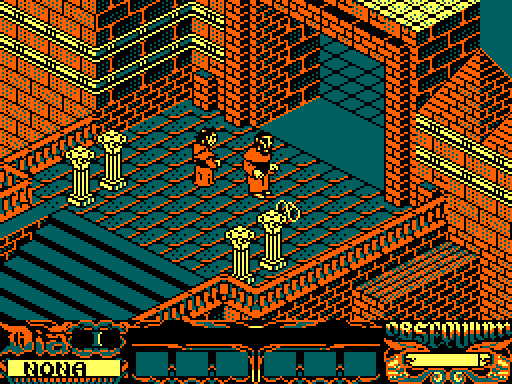
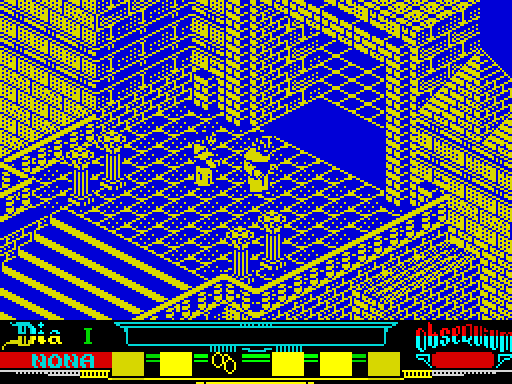
The abbey was born on an Amstrad CPC, crossed over to the ZX Spectrum with barely two colors and, almost forty years later, arrives on a console that predates both. Four full screens tell the story.
Plate I · 1987. Amstrad CPC: the original abbey, in four colors. Own screenshot with MAME from disk
Plate II · 1988. ZX Spectrum 128K: yellow ink on blue paper. This is the version the demake starts from. Own screenshot with the project's emulator
Plate III · 2026. Atari 2600: the same room in the demake, in its default mode: the full 128-pixel room, in a checkerboard that swaps on every frame and that the eye blends into a single image. Own screenshot in Stella
Plate IV · 2026. Atari 2600: STRIP+ mode, with the sharp 48-pixel window and the rest of the abbey hinted at in playfield. Own screenshot in Stella
You don't need an Atari to enter the abbey: the ROM runs right here, in your browser, with keyboard, gamepad or touch screen.
The Atari 2600 is the best-known console of its generation and one of the humblest: 128 bytes of RAM, no video memory at all, and a video chip (the TIA) that forces you to draw the screen line by line, at the pace of the electron beam. Bringing an entire abbey to it seems like heresy, and for that very reason it is an irresistible challenge.
This project does not aim to be a copy but a demake: a reinterpretation of the original using the tools of the 1977 console, helped by a modern cartridge with an ARM processor. It is the game we might have liked to have back then.