The Spanish magazines of 1987 and 1988 received La Abadía del Crimen (The Abbey of Crime) with high scores and some surprise: it did not resemble what was arriving at the time. This page collects the mentions we have been able to verify in the scans, with issue, date and page. The summaries are ours; from each review we quote only one short phrase.
The images are scans of the magazines themselves, taken from Archive.org and Computer Emuzone. All rights to the magazines and their contents belong to their publishers.
Before release
MicroHobby no. 150 · October 1987
Section New releases report, p. 28 (the article begins on p. 25)
Platform Amstrad CPC (Spectrum version announced)
Score none
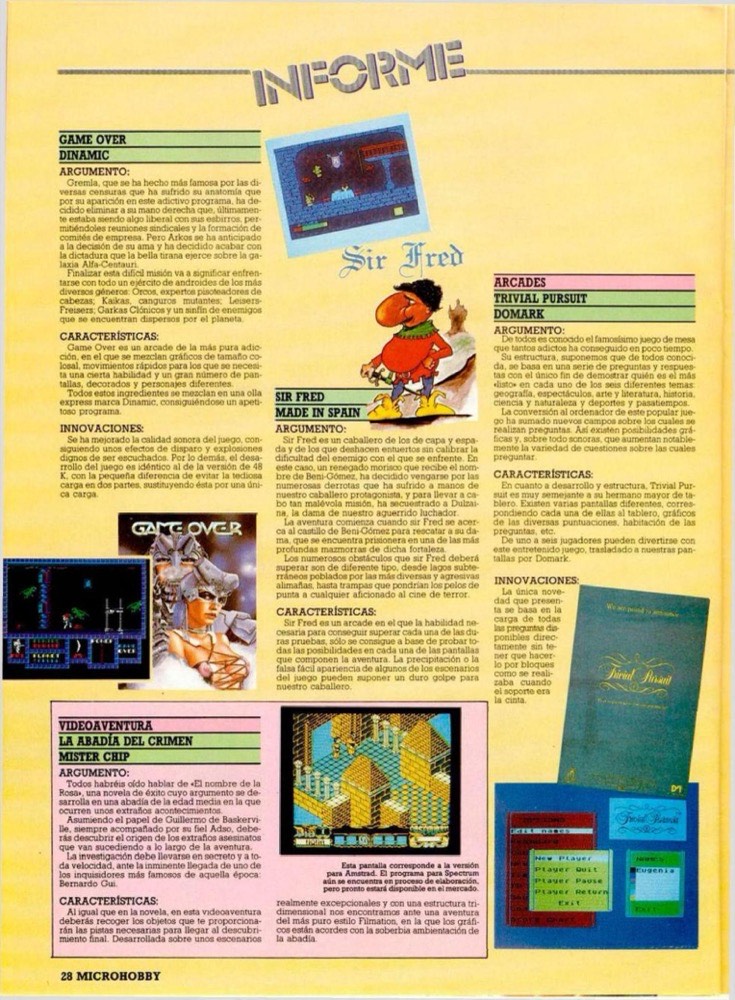
This is the first mention we have located, a month before the game's release on CPC. The entry presents the game as a video adventure from Mister Chip, summarizes the plot with William of Baskerville, Adso and the arrival of the inquisitor Bernard Gui, and speaks of «escenarios realmente excepcionales» [truly exceptional settings] in three dimensions. A footnote to the image clarifies that the screenshot is from the Amstrad version and that the Spectrum one was still in development.
Plate. MicroHobby no. 150, p. 28. Image: Archive.org
The reviews
Micromanía no. 31 (first series) · January 1988
SectionLo nuevo [What's new], pp. 16-17; by Cristina M. Fernández
Platform Spectrum 128, Amstrad and MSX
Score 9
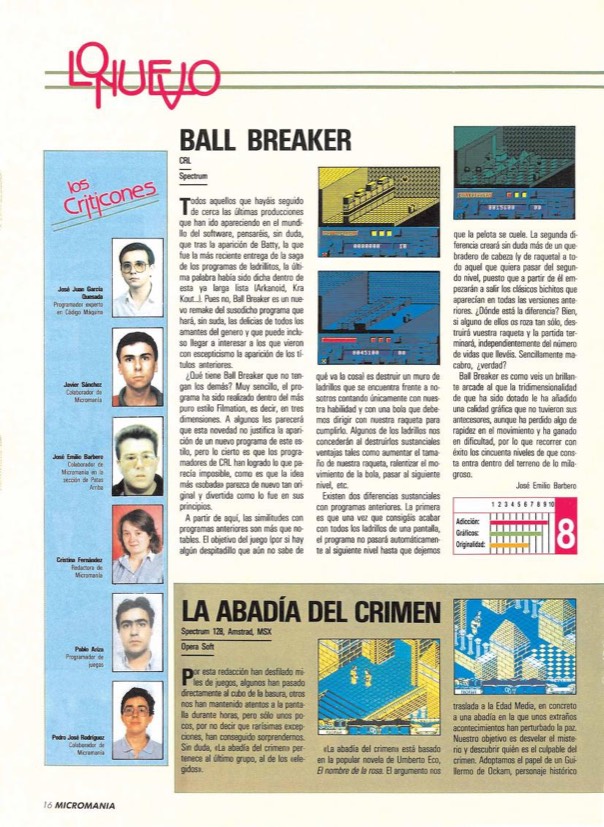
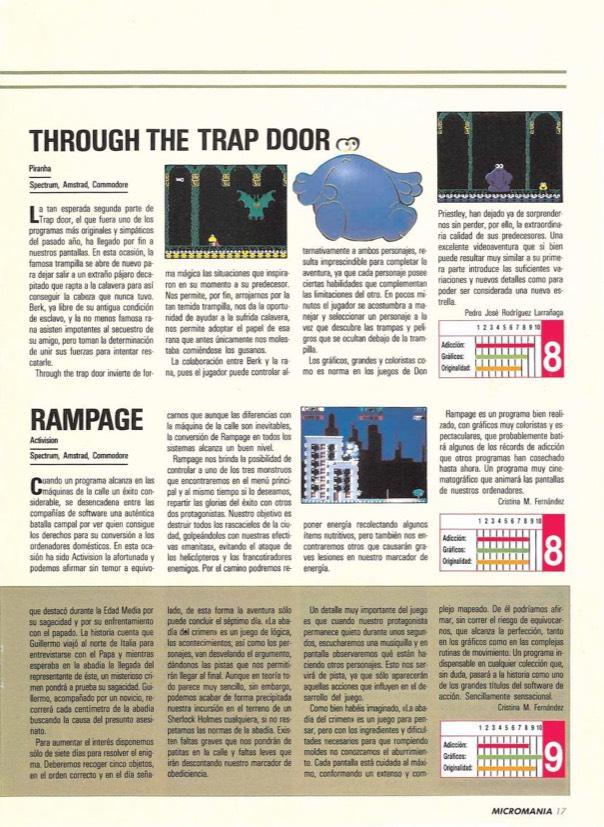
The editors say that thousands of games have passed through their hands and very few have surprised them; this is one of them. The review explains the premise (seven days, five objects that must be collected in the right order and on the right day, an obedience meter that drops with each offense) and highlights a practical detail: if the player stands still, the screen shows what the other characters are doing, and that serves as a clue. It says the map and the movement routines come close to perfection. It closes with «un programa indispensable en cualquier colección» [a program indispensable in any collection].
Plate. Micromanía no. 31, p. 16. Image: Archive.orgPlate. Micromanía no. 31, p. 17, with the score. Image: Archive.org
MicroHobby no. 162 · February 1988
Section New release review, p. 28; map on p. 30; interview with Paco Menéndez on p. 32
Platform ZX Spectrum 128K
Score a «5 estrellas» [5 stars] badge on the page (Computer Emuzone records it as 9/10)
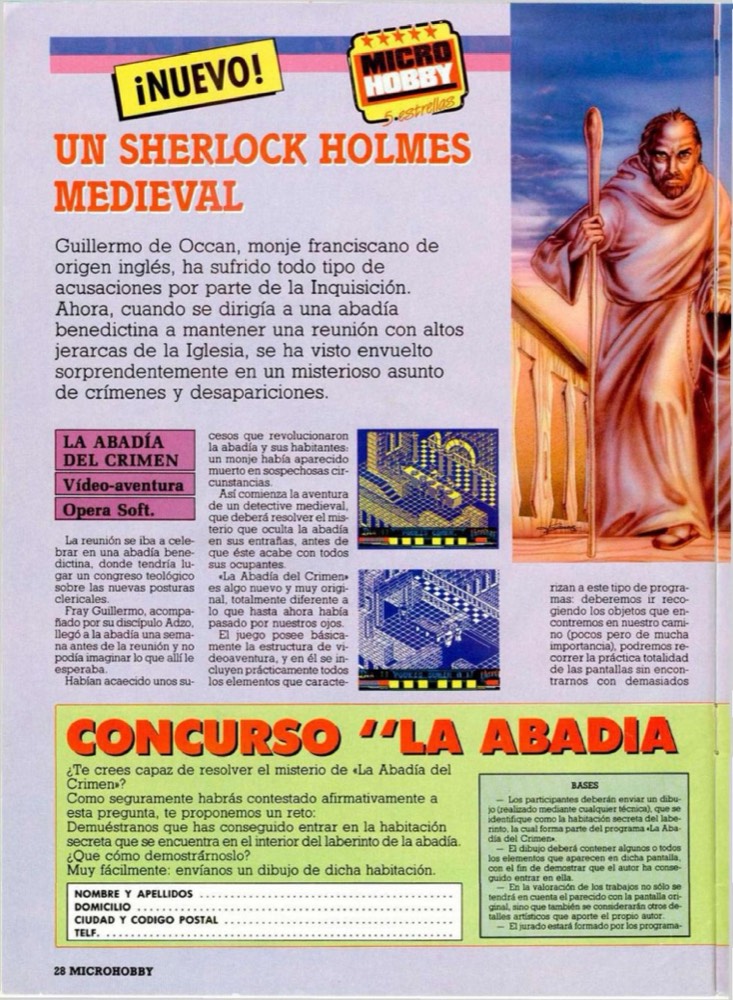
Titled «Un Sherlock Holmes medieval» [A medieval Sherlock Holmes], the review presents the game as something «nuevo y muy original» [new and very original] within the video adventure genre. It stresses that you control two characters at once, that the rest of the monks react to what you do (they chase you, take objects from you, tell you secrets) and that you can save the situation to resume it if you are eliminated. Of the graphics it says they have a quality rarely seen on a Spectrum. The same page announces a contest: send in a drawing of the secret room of the labyrinth.
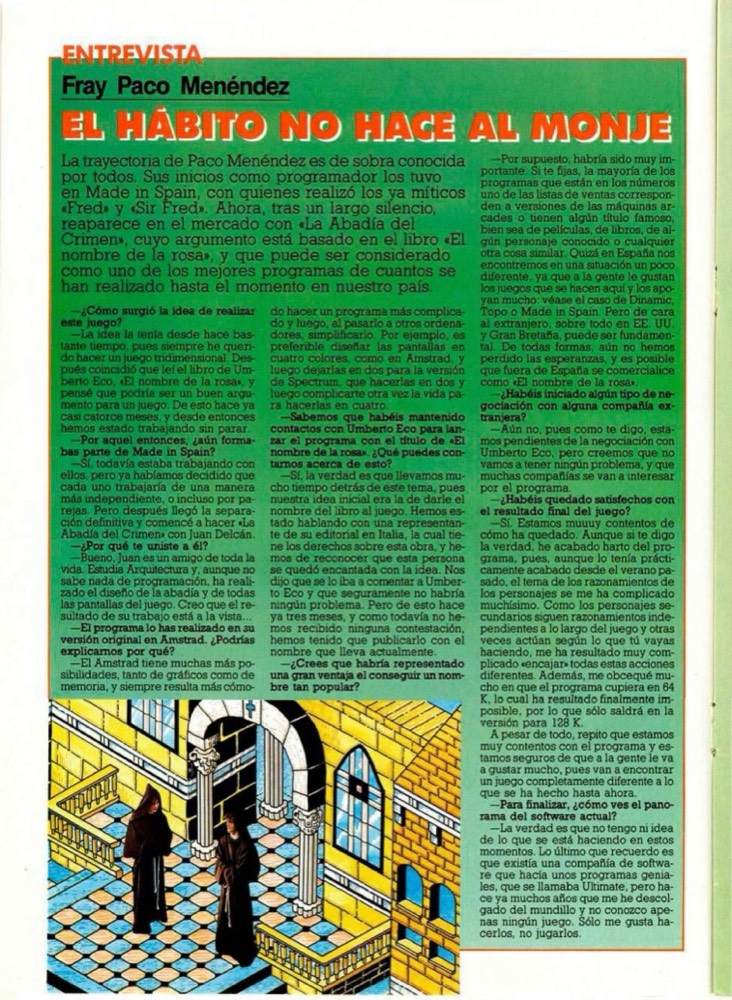
The interview on p. 32, titled «Fray Paco Menéndez» [Brother Paco Menéndez], is the most useful document in the issue. Menéndez says that he wanted to make a three-dimensional game, that he read The Name of the Rose and that he had been working on the project for about fourteen months. He introduces Juan Delcán as a lifelong friend, an architecture student, who designed the abbey and all the screens without knowing how to program. He explains that he did it first on the Amstrad because it is easier to simplify afterward, and that he insisted it fit in 64 K, which proved impossible, so only the 128 K version would be released (in time, a 64 K version did come out). On Eco: they had spoken with a representative of his publisher in Italy, who promised to look into it, but three months later they still had no reply and had to release the game under its current title.
Plate. MicroHobby no. 162, p. 28. Image: Archive.orgPlate. MicroHobby no. 162, p. 32: interview with Paco Menéndez. Image: Archive.org
Amstrad Personal no. 6 · February 1988
Section Games, «Este mes» [This month], pp. 40-43
Platform Amstrad CPC
Score none visible in the scans
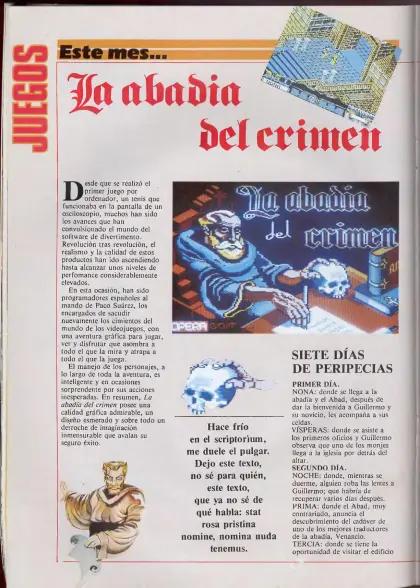
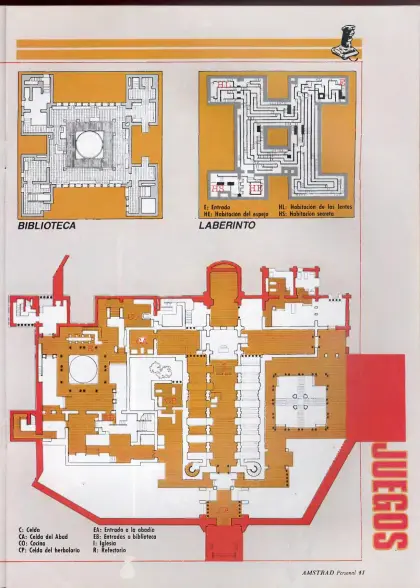
Four pages devoted to the game. The text praises the graphic quality, the careful design and the intelligence of the characters, and includes a day-by-day account («Siete días de peripecias» [Seven days of adventures]) with the canonical hours, along with plans of the library, the labyrinth and the main floor. The issue, date and page details come from the Computer Emuzone entry.
Plate. Amstrad Personal no. 6, first page of the article. Image: Computer EmuzonePlate. Amstrad Personal no. 6, plans of the abbey. Image: Computer Emuzone
Micromanía no. 33 (first series) · March 1988
Section cover and guide with map, pp. 73-78
Platform Spectrum, Amstrad and MSX
Score not a review, so no score
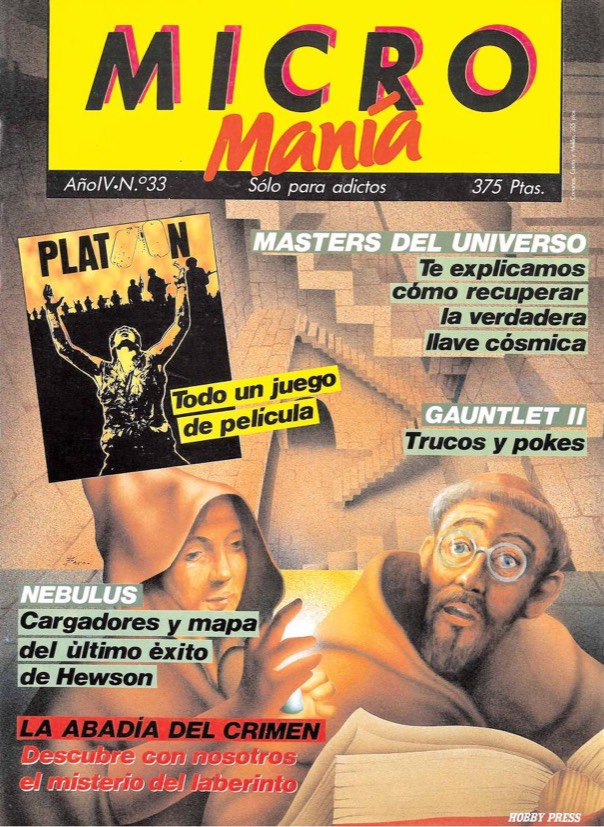
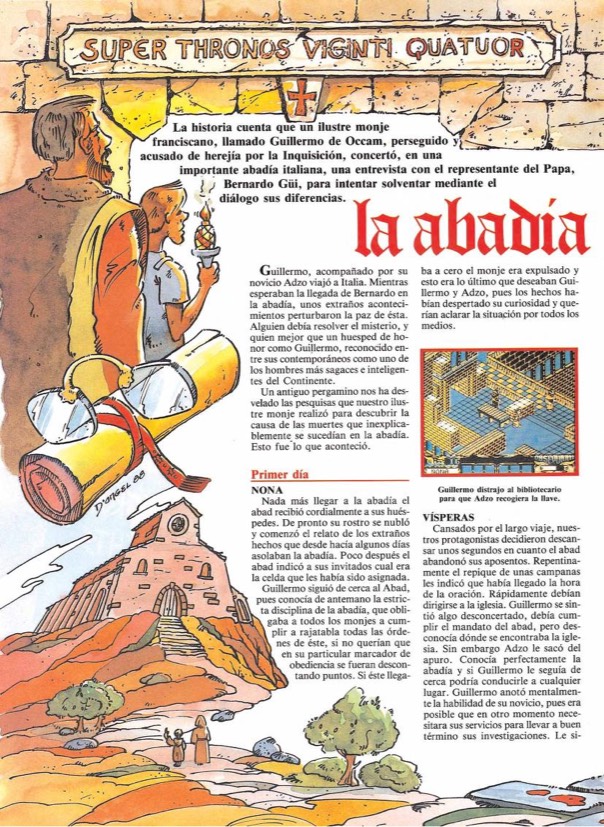
Two months after its review, Micromanía devotes its cover to the game («Descubre con nosotros el misterio del laberinto» [Discover the mystery of the labyrinth with us]) and several illustrated pages. The guide is written as an account of what William and Adso did each day, starting from None on the first day, and points out specific tricks, such as distracting the librarian so that Adso can pick up the key.
Plate. Cover of Micromanía no. 33. Image: Archive.orgPlate. Micromanía no. 33, opening of the guide. Image: Archive.org
MSX Extra no. 41 · March 1988
SectionBit-Bit, game software, p. 14
Platform MSX (cassette)
Score total 9 (presentation 9, graphics 9, movement 9, sound/music 7, addictiveness 9, difficulty 10)
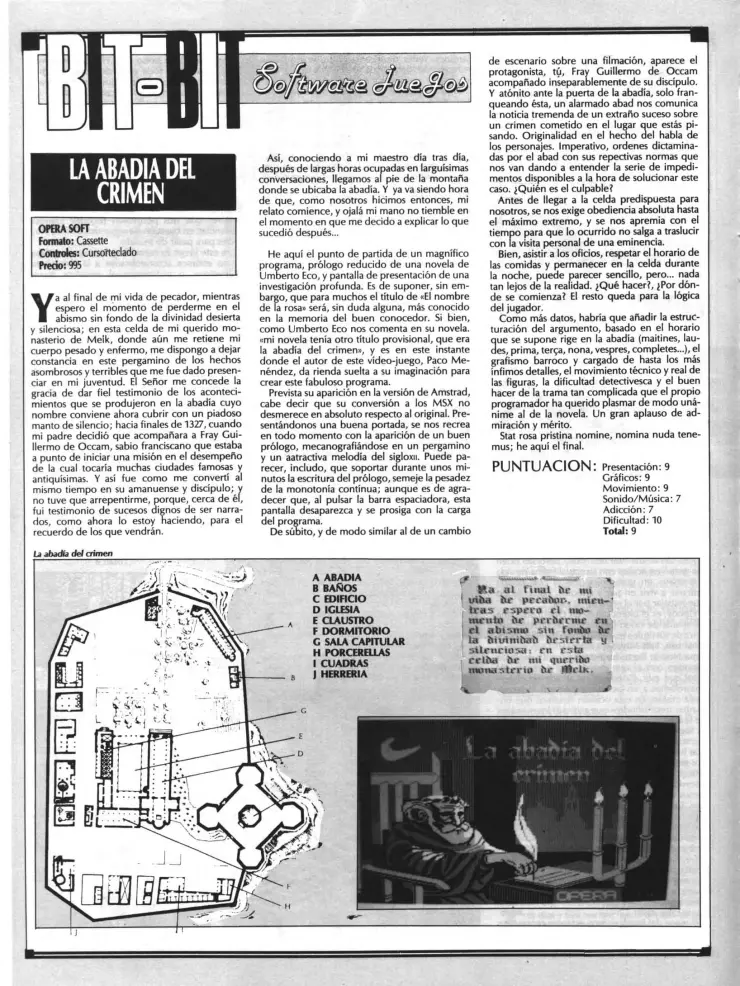
The review imitates the tone of the novel's prologue: it opens with a narrator writing in his cell. It then explains that the title was the working title of Eco's book, says that the MSX conversion respects the original, and praises the title screen and the loading tune. It admits that the prologue written on screen becomes somewhat tedious, although it can be skipped with the space bar. It discusses the abbey's hourly structure and the difficulty of the investigation, and ends with «un gran aplauso de admiración y mérito» [a great round of applause for admiration and merit].
SectionLos justicieros del software [The software avengers], p. 49
Platform Spectrum
Score ratings from eight readers, no overall score
Eight readers rate two games, Phantom Club and La Abadía del Crimen, with charts by category and a short comment. For most of them the abbey is exceptional or a masterpiece, above all for the graphics and the story. There are also reservations: one finds it not very addictive, another criticizes disappointing sound and movement. We do not reproduce the page because it includes photos of the participants.
Micromanía no. 3 (second series) · August 1988
SectionPunto de mira [In the sights], PC, p. 18; by C. F. A.
Platform PC (MS-DOS)
Score 9
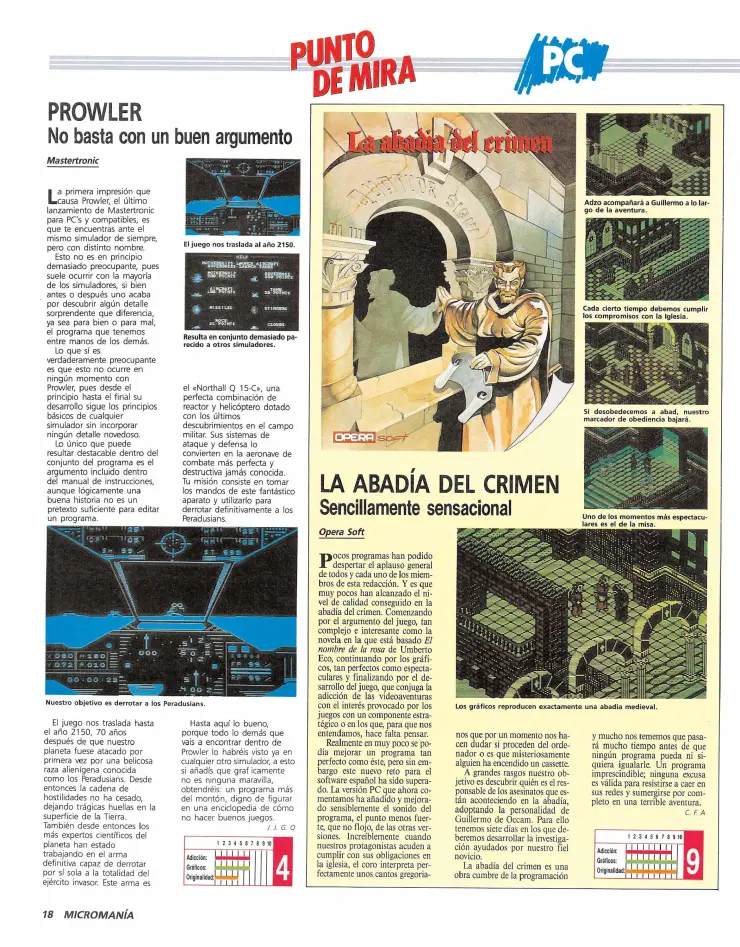
The PC version is headlined «Sencillamente sensacional» [Simply sensational]. The editors state that few programs have been so widely applauded by the whole team. They argue that the PC version noticeably improves the sound, which was the weakest point of the others, and that the graphics reproduce «exactamente una abadía medieval» [exactly a medieval abbey]. They believe it will be a long time before another program equals it.
«Sencillamente sensacional.» [Simply sensational.]Micromanía (2nd series) no. 3, August 1988
What came after
In 2014 the book Obsequium, by Jaume Esteve Gutiérrez, reviewed the cultural and technical history of the game. In May 2017 the Spanish post office, Correos, issued a stamp in its honor, and that year the Museo Histórico de Informática of the Universidad Politécnica de Madrid organized an exhibition. The details are on the History page.