The ROM is in ELF format, the ARM-based cartridge format the demake uses. It is a test build: the game is complete, and it has already booted on a real console with a PlusCart, but it has not been tested thoroughly on hardware yet.
Liber VIII
Downloads
What exists, what is coming, and where to play it.
The Atari 2600 ROM
Download the ROM (zip) The .bin (Stella, PlusCart, UnoCart) The .elf (Chameleon Cart) Play in the browser
Build of 2026-11-01 17:53 · commit a821ffb · 142 KB ROM, 146 KB Chameleon ELF, 197 KB zip · MD5 40b6f804e048fa14fe101d6a30d00716
The zip holds two files: abadia2600.bin, the ROM for the emulators, the PlusCart and the UnoCart, with a .pro file that gives it its name in Stella, and abadia2600-chameleon.elf, the version for the Chameleon Cart. Both work for NTSC, PAL 60 and PAL 50: the TV system is chosen in the title screen menu. You can play it on:
- Emulators: Stella 7.0 or later, where everything has been tested, and Gopher2600 0.58 or later.
- Original console: the target cartridge is Phantom Logic Studios' Chameleon Cart, created by Zackary Scolaro (ZackAttack), where the game already runs, pause and SaveKey included. A separate version is built for it, linked with its firmware, the
.elffile; since the current firmware does not have bus stuffing yet, for now it only offers DOUBLE and STRIP, and the other modes will come with the new firmware. On a PlusCart it runs from version 2.3.32 of the firmware by its creator, Wolfgang Stubig (Al_Nafuur); if yours is older, update it: 2.3.28 and earlier do not load it, because their loader reads the file into a 96 KB buffer and it does not fit. The UnoCart with UCA firmware has not been tested. - Optional: a SaveKey or an AtariVox in the right port, to save the game and restore it after switching off.
It will not work on Harmony or Melody cartridges, or on the Atari 2600+ and 7800+ consoles, which do not support the ELF format.
How to play
On the title screen, the button opens a menu with four settings: SYSTEM (the TV system), LANGUAGE (Spanish or English), display MODE and HMOVE (leave it on NORMAL unless you have a late 2600 Jr. or a PAL 7800, where DOUBLE and FULL may need SHORT; the Chameleon Cart picks it by itself). Up and down choose the setting, whose value appears below it; left and right change it, with arrows showing which way it can go, and the button starts the game. On the PlusCart and the UnoCart there is a fifth row, EXIT, with the cartridge's name below it: the button on it returns to the cartridge's menu to choose another game.
| Mode | What you see |
|---|---|
| FULL | The whole room in high resolution, in a checkerboard of blocks that swaps on every frame, with the Spectrum scoreboard. This is the default mode. |
| DOUBLE | A 96-pixel window, also in a checkerboard, with a narrow version of the Spectrum scoreboard. |
| STRIP+ | A sharp 48-pixel window that follows William, with the rest of the room hinted at in playfield. No flicker. |
| STRIP | Only the 48-pixel window. No flicker and no bus stuffing. |
| Control | Effect |
|---|---|
| Up | Walk forward |
| Left / right | Turn, once per press, as in the original |
| Button | Drop the object; objects are picked up automatically. On the parchments, skip |
| Down (held) | Move Adso out of the way |
| Left / right at the night question | Answer yes or no |
| SELECT | Pause, with a menu to resume and, with a SaveKey or AtariVox, to save or load the game |
| Left difficulty | The room's height map: it shows when the switch is moved from the position it was in when the game started |
| Right difficulty | Game pace: the position it is in when the console is switched on is the fast pace, the original's nominal one (one tick every 0.12 s); the other one, the slow pace the Spectrum was played at (each tick 28% longer). When it is changed, the scoreboard shows the chosen pace for about two seconds |
| RESET | Back to the title screen |
FULL and STRIP+ use bus stuffing, a technique that some consoles, such as certain PAL 7800s and the Atari Jr., do not tolerate; on those, use DOUBLE or STRIP. On the Chameleon Cart, until its new firmware comes out, the menu only offers those two and starts in DOUBLE.
A proposed physical edition
There is also a proposal for a physical edition, in the style of the cartridges of the time: a box with Juan Delcán's original cover art, a 32-page manual in Spanish and English, and the cartridge with its label. It is only that, a proposal: whether it ever exists will depend on circumstances.
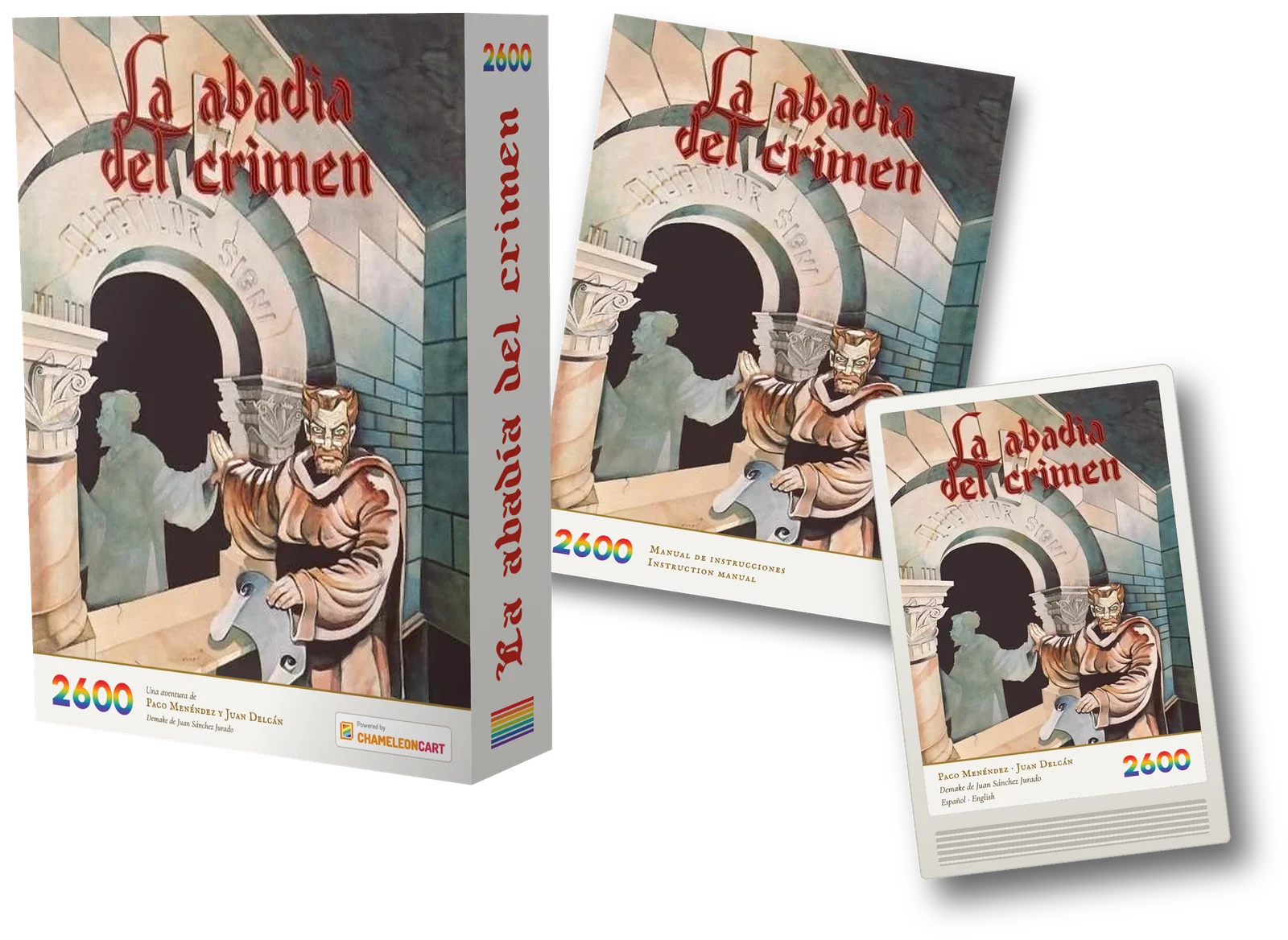
Cover illustration: Juan Delcán (1987)
Other versions you can play today
- La Abadía del Crimen Extensum (2016), by Manuel Pazos and Daniel Celemín. Free for Windows, macOS, and Linux, also on Steam.
- VigasocoSDL, the engine based on Manuel Abadía's reverse engineering, for Linux, Mac, and other systems.
- MSX2 version (2001) by Manuel Pazos, which can be played in the browser from its Computer Emuzone entry.