Who lives in the monastery, and what the building is like.
Spoiler alert! The character entries reveal that some of the monks die during the week. If you would rather find out which ones, skip the entries. They never give away the culprit or how the case is solved.
The characters
The game does not use the novel's name for its protagonist, but the cast is that of The Name of the Rose: a Franciscan and his young assistant arrive at a Benedictine abbey for a theological meeting and, as soon as they arrive, the Abbot asks them to find out the cause of a death. Below each entry appears the equivalent character in the novel.
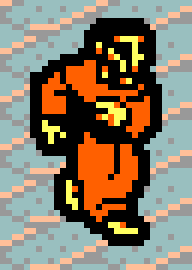
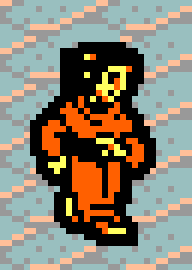
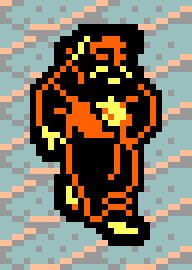
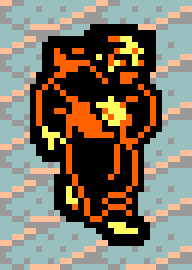
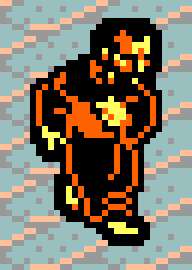
The character pictures are graphics from the original game (Juan Delcán, 1987), in Amstrad CPC colors and on a lightened tile from the game.
Brother William of Occam
He is the character the player controls: a Franciscan who investigates the crimes and who must also follow the rules of the abbey (attend the services and the meal, be in his cell at night). His name alludes to William of Ockham, the medieval philosopher.
In the novel: William of Baskerville. The change of name is explained on the History page.
Adso
The novice who accompanies William. According to the manual, he can only be directed while he is on the same screen as William; otherwise he follows William on his own. He can carry two objects, compared with William's six, and now and then he speaks up with lines such as "We must find a lamp, master."
In the novel: Adso of Melk, the Benedictine novice who, as an old man, narrates what happened.
The Abbot
He receives William at the entrance and explains that he must obey the Abbot's orders and those of the abbey. He is the one who expels the player for missing Mass or the meal, or for being caught outside his cell at night. He also takes part in the handing out of objects, for example when he demands the parchment.
In the novel: Abo of Fossanova, the abbot of the abbey.
Malachi
He is the librarian. According to a line spoken by the Abbot, the library is a secret place that only Malachi may enter, so the player cannot simply go up to it.
In the novel: Malachi of Hildesheim, the librarian.
Berengar
He works in the scriptorium. One line in the game says that, if William wishes, Berengar will show him the scriptorium, where "the best copyists in the West" work. Later the Abbot announces that he has disappeared.
In the novel: Berengar of Arundel, the librarian's assistant.
Severinus
He introduces himself as the person in charge of the hospital and warns William that strange things are happening in the abbey: someone does not want the monks to decide for themselves what they should know.
In the novel: Severinus of Sankt Wendel, the herbalist.
Venantius
He is the monk whose murder the Abbot announces to the other monks. In the scriptorium, the place where he worked is pointed out ("Venantius worked here") and another line mentions his manuscript. He does not appear on screen: none of the monk heads stored in the game belongs to him.
In the novel: Venantius of Salvemec, a Greek translator in the scriptorium.
Jorge
The Abbot introduces him as "the oldest and wisest man in the abbey." Jorge greets William with a warning about the Antichrist and asks him not to waste the last days. He reappears at the end of the week.
In the novel: Jorge of Burgos, the old blind monk. The forbidden book is not the same: in the game, the Coena Cypriani takes the place of the Poetics.
Bernard Gui
The inquisitor. The Abbot wants the case solved before his arrival, so that the name of the abbey is not tarnished. When he arrives, the Abbot warns that William must abandon the investigation.
In the novel: Bernard Gui, a historical inquisitor (in the game he keeps his real name, as in the book).
The monks on screen
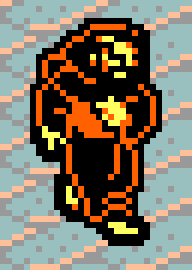
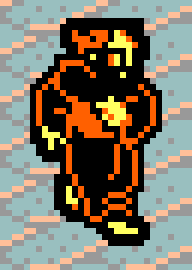
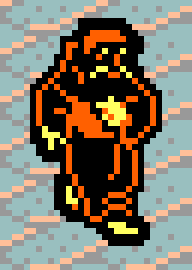
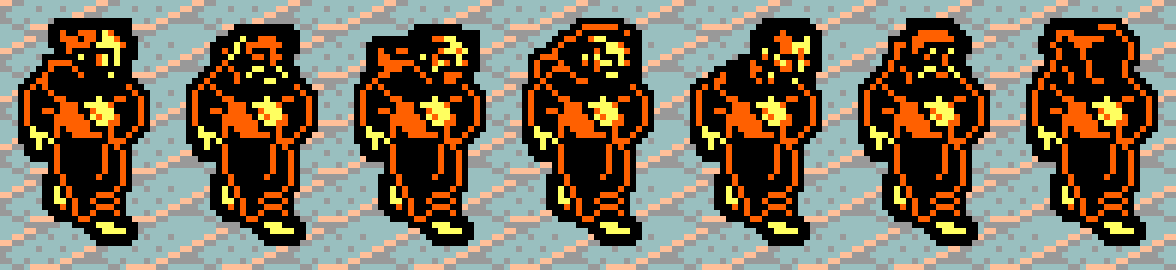
The monks are not drawn like William and Adso, who are whole sprites. Each monk is assembled from a head 10 rows tall and a habit body shared by all of them. The game stores 14 heads in pairs, front and back, and 12 body drawings. Taking the code apart for the demake revealed whose each pair is: Severinus, the Abbot, Malachi, Berengar, Bernard Gui, Jorge and, last, Berengar with his hood up.
Plate. The seven monk heads on the shared body, from left to right: Severinus, the Abbot, Malachi, Berengar, Bernard Gui, Jorge and Berengar with his hood up.
The abbey
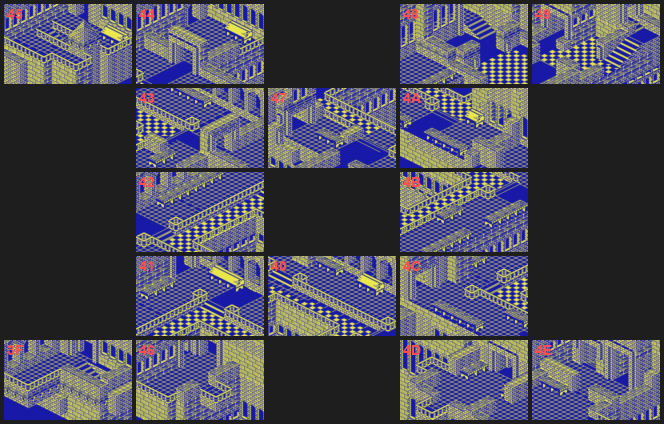
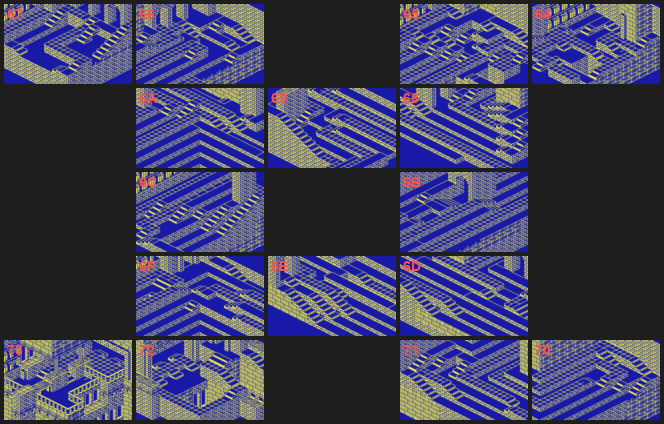
The game has 94 fixed screens spread over three floors. The ground floor holds most of them (62 screens, including the outdoors; two of them are empty). The first floor, with 16 screens, is the scriptorium. The second, also with 16, is the library, which without the lamp is seen in darkness even though the map exists.
Ground floor. 62 screens, with their hexadecimal number in red. 3E appears twice: it is William and Adso's cell, entered through the door at the back of 37, and the game uses the same drawing for another identical cell. Graphics from the original game (Juan Delcán, 1987), extracted by the project
First floor, the scriptorium. 16 screens. Graphics from the original game (Juan Delcán, 1987), extracted by the project
Second floor, the library. 16 screens. Graphics from the original game (Juan Delcán, 1987), extracted by the project
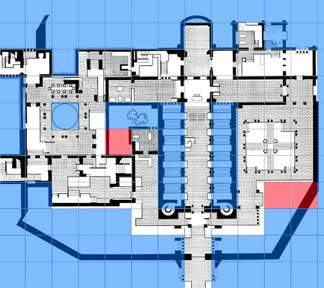
In 2003 Manuel Pazos drew the complete plan of the abbey, including the rooms that the original game keeps hidden. It is reproduced on the Heirs page and here as an overall reference.
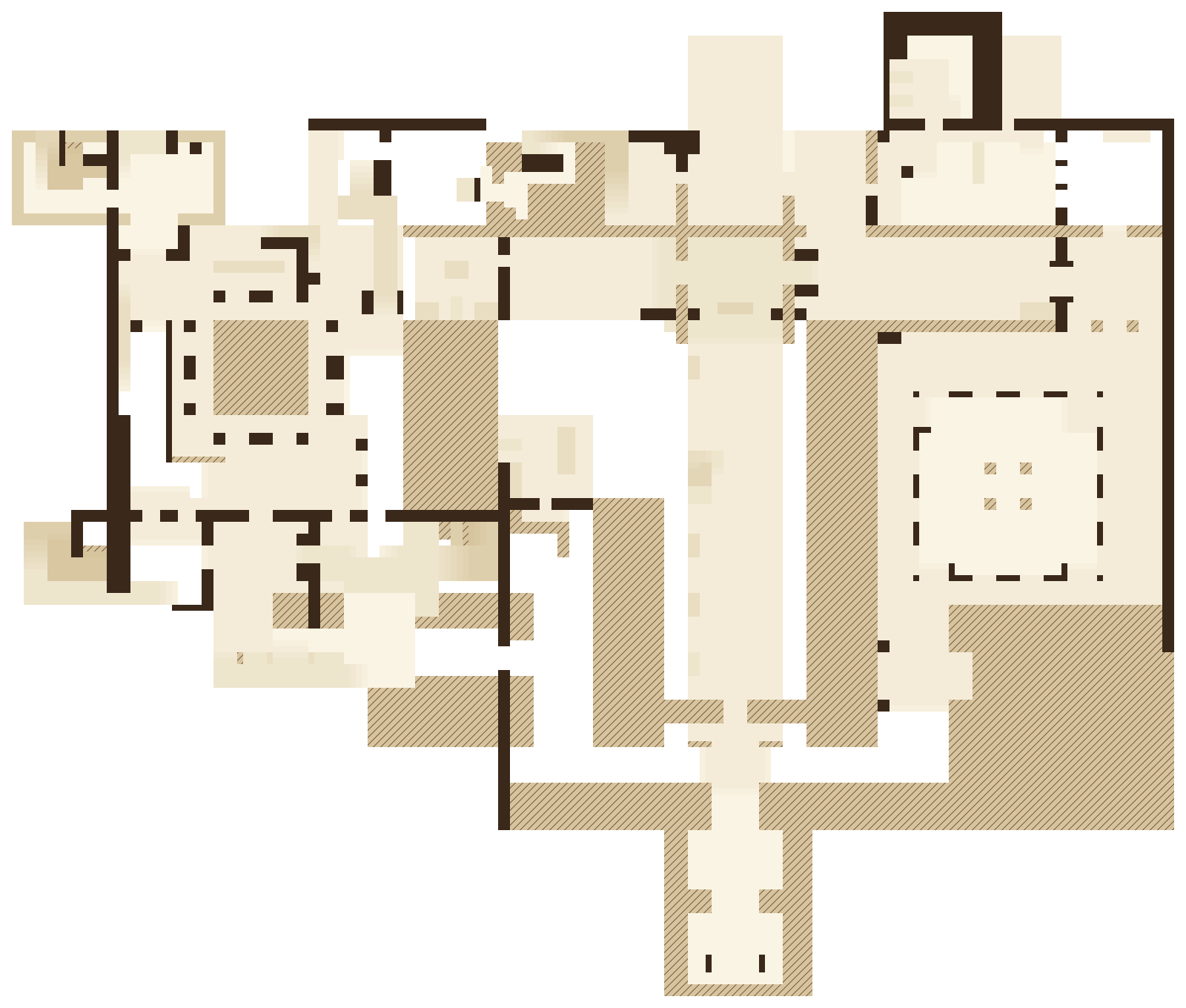
This map of the ground floor is made from the game's height table: the same one the characters use to know where they can walk. The names sit where the game's scripts place them. The scriptorium is on the first floor of the Aedificium, and the library, above it, is left out: that map is for the player to draw.
Map of the ground floor. Walls are in ink; hatched areas can't be walked on. The darker the floor, the higher it is.
The canonical hours
Each day is divided into seven periods, which are the canonical hours of the monastic office and which the game shows on its scoreboard. According to the Computer Emuzone entry, they are numbered 0 to 6 for scoring purposes.
Order
Hour
In the abbey
0
Night
Sleep in your cell. Adso asks whether you are going to sleep; it is also the time to explore in secret.
1
Prime
Mass in the church.
2
Terce
From day 2 on, the Abbot calls you and tells you the news of the day. Then, investigate.
3
Sext
Meal in the refectory.
4
None
Free to investigate. Day 1 is the arrival: the Abbot welcomes you and shows you the abbey.
5
Vespers
Mass in the church.
6
Compline
To your cell: the Abbot walks you to the door and does not leave until you go in.
The Abbot demands attendance at the services and the meal, and at night the player should be in his cell.
The seven days
The story takes up one week: seven days during which William must carry out the duties of a monk and, in his free time, investigate. The scoreboard shows the day in Roman numerals, as in the original.
What happens exactly each day and at what hour is part of the game's solution and is not detailed on this page. Those who want the complete guide can consult the manual and solution sections of the game's entry on Computer Emuzone, with the warning that the solution gives away the case.
Obsequium
Obsequium is William's obedience bar. Minor offenses, such as arriving late or entering where he should not, make it drop. If it runs out, or if the player commits a serious offense (missing Mass or the meal, or being caught by the Abbot outside his cell at night), the Abbot expels him and the game ends with a line like "Leave this abbey forever."
In the demake the bar is red in every mode, as on the Spectrum, and gets shorter as it drops. In every mode it is made of the console's playfield.