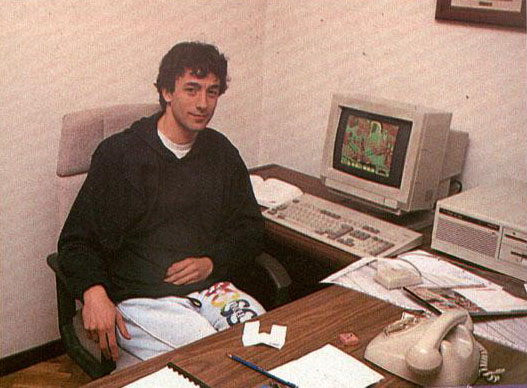
Paco Menéndez was already a prominent figure in Spanish software before the abbey. His Fred (1983), a pyramid-exploring game, and its sequel Sir Fred (1986) had made him well known. He was also a telecommunications engineering student.
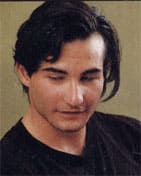
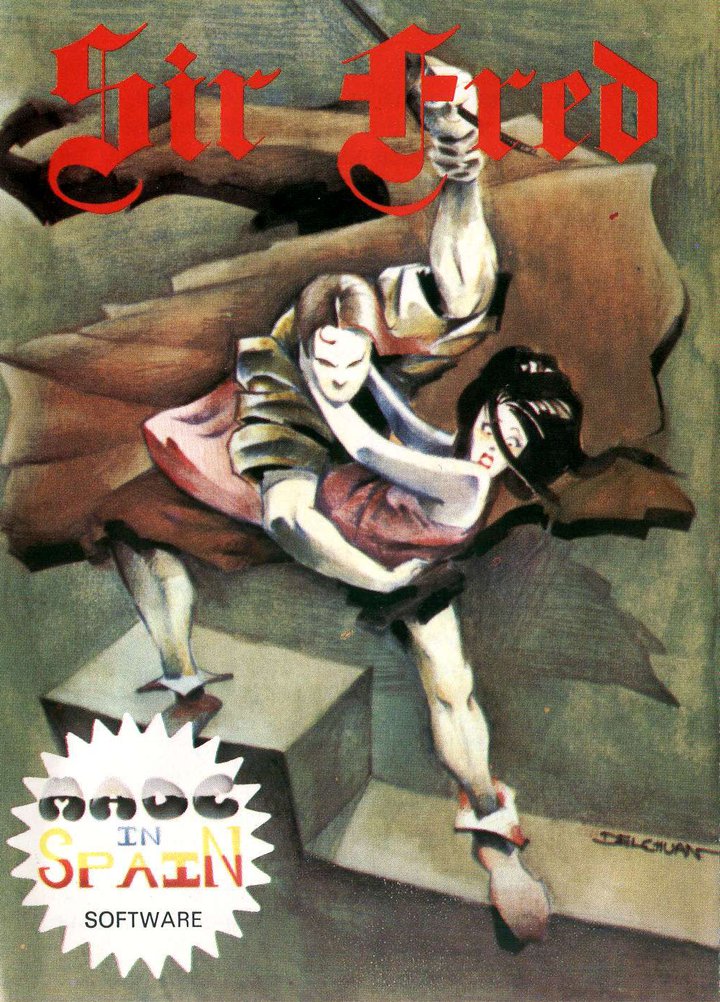
Juan Delcán was his childhood friend and studied architecture. He hardly played video games, but he drew on graph paper and converted his drawings into pixels. They had already worked together: the cover of Sir Fred is his. In the abbey, he is responsible for the isometric perspective and for a camera system inspired by film, which makes the abbey feel like a real building rather than a stage set.
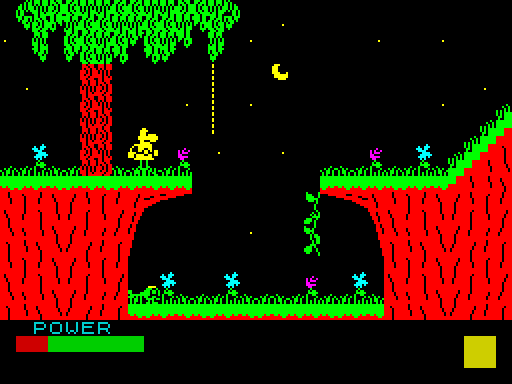
Plate. The cover of the original release of Sir Fred (Made in Spain, 1986), drawn by Juan Delcán, with his signature at the bottom right. Image: Spectrum ComputingPlate.Sir Fred on the ZX Spectrum. Screenshot: Spectrum Computing
The idea
The starting point was Umberto Eco's The Name of the Rose, whose working title had been, precisely, The Abbey of Crime. For about fourteen months, Menéndez and Delcán worked in a small room in Madrid on an Amstrad CPC. Menéndez wrote a custom drawing tool for Delcán, and, as the story goes, he worked out much of the program in his head before typing it in.
The result was seven days divided into canonical hours, an Obsequium bar that measures the Abbot's patience, and monks who follow their own routines throughout the abbey. Menéndez wanted to give them a more complex intelligence, but the game was almost finished and he would have had to start over. The music was taken from Bach, from the Notebook for Anna Magdalena and the Flute Sonata BWV 1033, and from Crystal Palace by the French group Gwendal (more in Music).
The silence of Umberto Eco
The authors wanted to make an official adaptation and asked Eco for the rights to the novel. The reply never came. In an interview in MicroHobby (no. 162, February 1988), Menéndez said that Eco's Italian publisher had gone three months without answering (see Press). Without a license, the game had to keep its distance from the novel.
William of Baskerville became William of Occam, and the forbidden book stopped being Aristotle's Poetics and became the Coena Cypriani. The title, on the other hand, stayed as a discreet tribute to the name Eco had discarded.
Release and Opera Soft
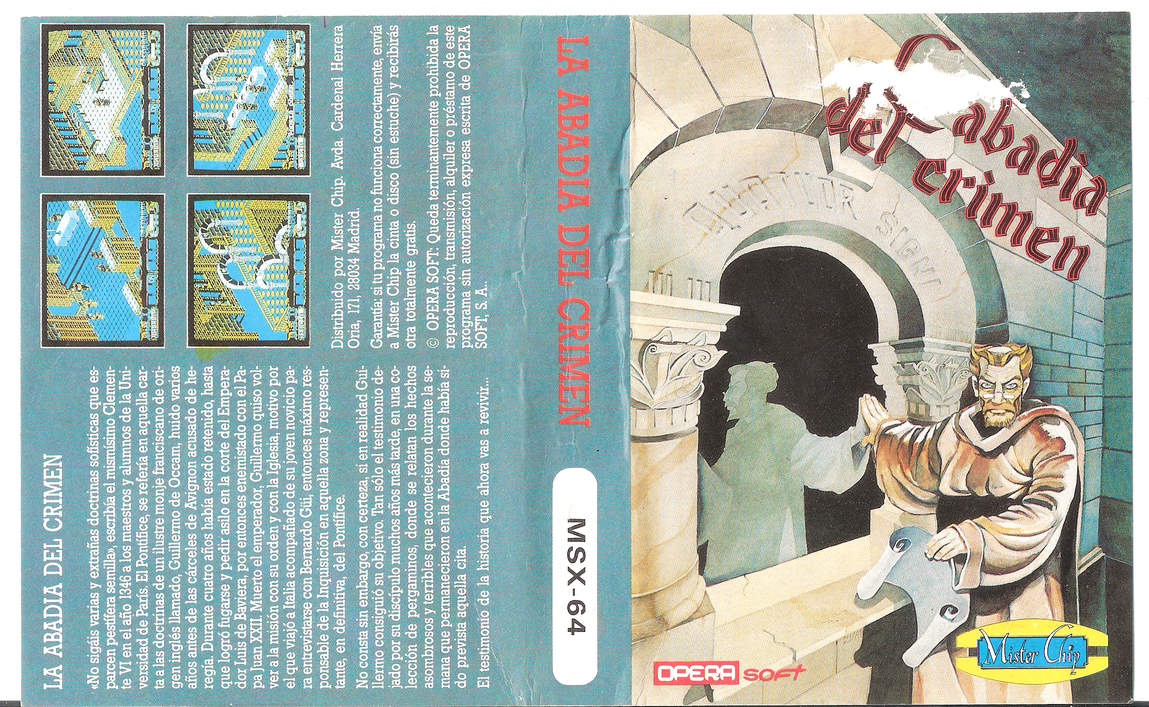
The game came out in late 1987 for Amstrad CPC. At first it was distributed by Míster Chip, the Madrid computer academy run by Menéndez's family; in October, MicroHobby was already announcing it as a Míster Chip game. Covers from the period already showed the Opera Soft logo next to that of Míster Chip.
The definitive acquisition came later: on February 1, 1989, Menéndez and Delcán signed over the rights to the game to Pedro Ruiz, director of Opera Soft. With that, La Abadía del Crimen (The Abbey of Crime) became forever linked to one of the leading companies of the Golden Age of Spanish software.
Commercial success was modest, and many players gave up within a few days: it was difficult on purpose. Over the years it became a cult classic. Paco Menéndez, disenchanted with the industry, left video games, finished his degree and went on with his own research. He died in 1999, aged 34.
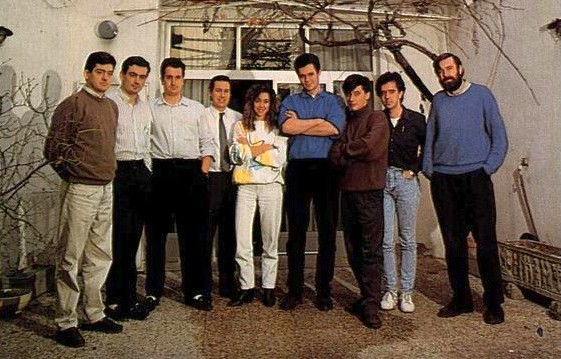
Plate. Cover of the edition distributed by Míster Chip, with the Opera Soft logo. Image: MSXBlogPlate. The Opera Soft team in 1989, the year the rights were transferred. Photo: MSXBlog
The period ports
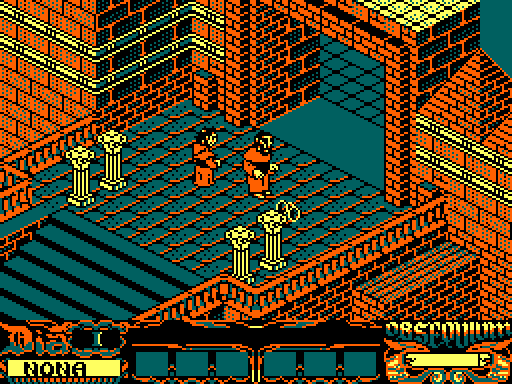
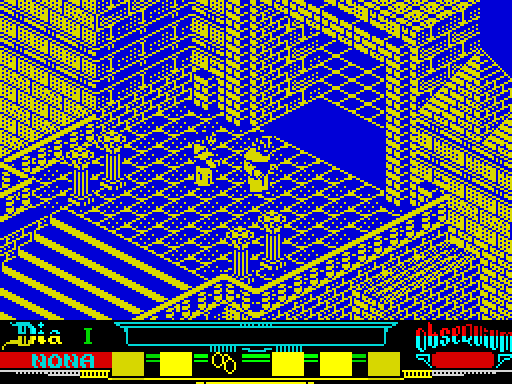
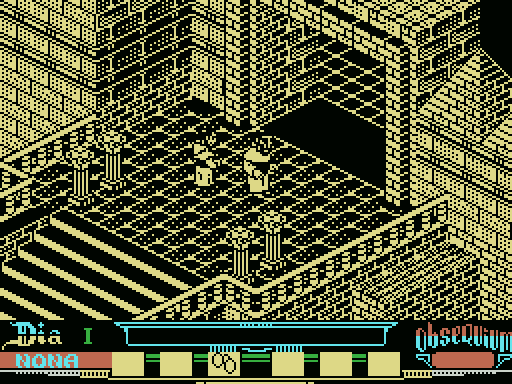
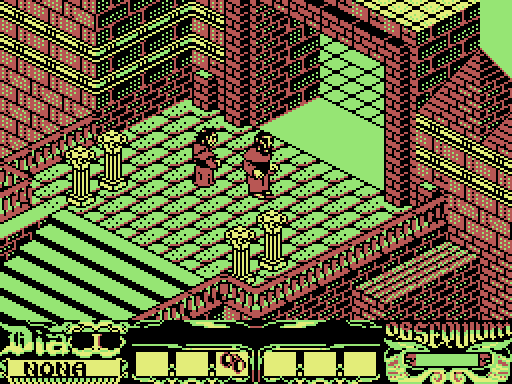
Amstrad CPC 6128 · Nov. 1987. The original version. There was also a reduced edition for the CPC 464/664, with fewer rooms. Own screenshot with MAME from diskZX Spectrum 128K · Jan. 1988. 128K only; reviewed in MicroHobby no. 162. Own screenshot with the project's emulatorMSX · Jan. 1988. Own screenshot with openMSX from the ROMPC (MS-DOS) · Aug. 1988. With Schubert's Ave Maria and a famous anti-copy warning at Vespers. Own screenshot with DOSBox Staging (CGA)
The loading screens
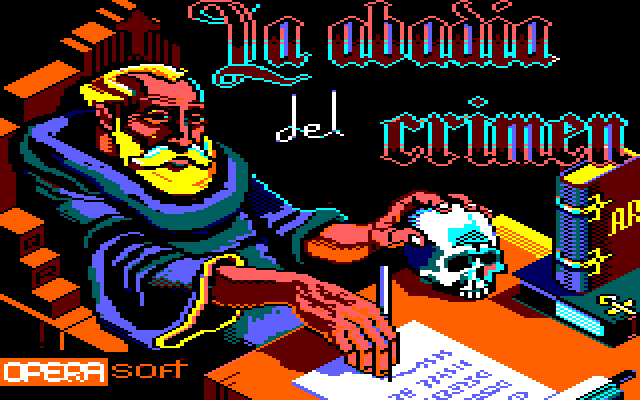
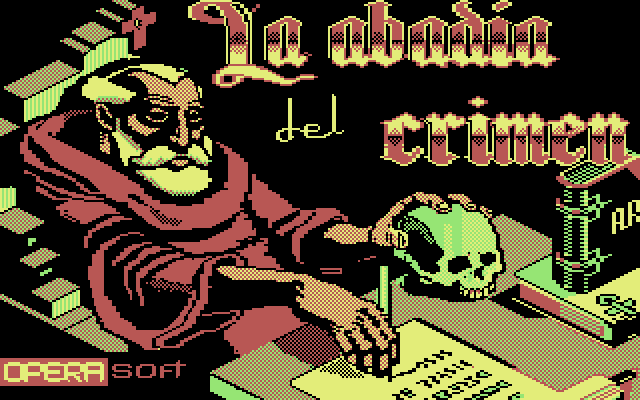
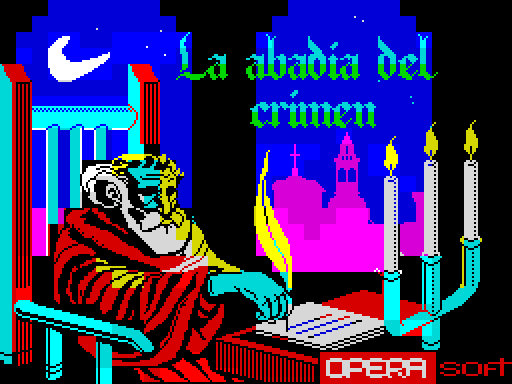
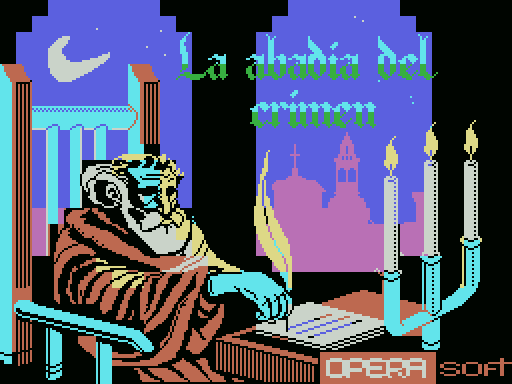
There are two title illustrations. The CPC and PC ones come from the same drawing, the monk with the skull; the Spectrum and MSX ones share another: an old monk writing at night by the light of three candles, before a window with the moon and the silhouette of the abbey. That is the one the demake redraws for the TIA.
Amstrad CPC. Own screenshot with MAMEPC (CGA). Converted by the project from the ABADIA.PIC file, with DOSBox colorsZX Spectrum. Original loading screen: Spectrum ComputingMSX. Own screenshot with openMSXAtari 2600 (demake). Own screenshot with Stella
The legacy
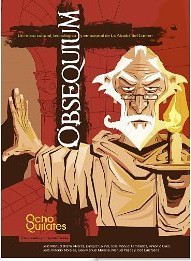
In April 2014, Jaume Esteve published Obsequium, "a cultural, technological and emotional account" of the game, with contributions from Antonio Giner and Manuel Pazos, among others. In May 2017, Correos issued a stamp dedicated to it, designed by Juan Delcán himself, the first in Spain dedicated to a video game, printed with thermochromic ink that reveals six objects. That same year the Museo Histórico de Informática of the Universidad Politécnica de Madrid held an exhibition on it, and since 2019 the university has awarded the Menéndez-Delcán video game prize.
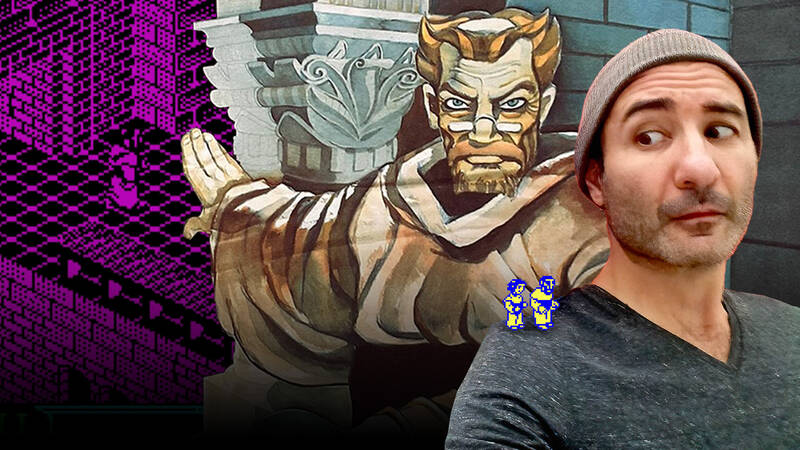
Obsequium (Ocho Quilates, 2014), by Jaume Esteve. Cover: Ocho QuilatesPlate. Juan Delcán, decades later, next to his Brother William. Image: El Mundo del Spectrum