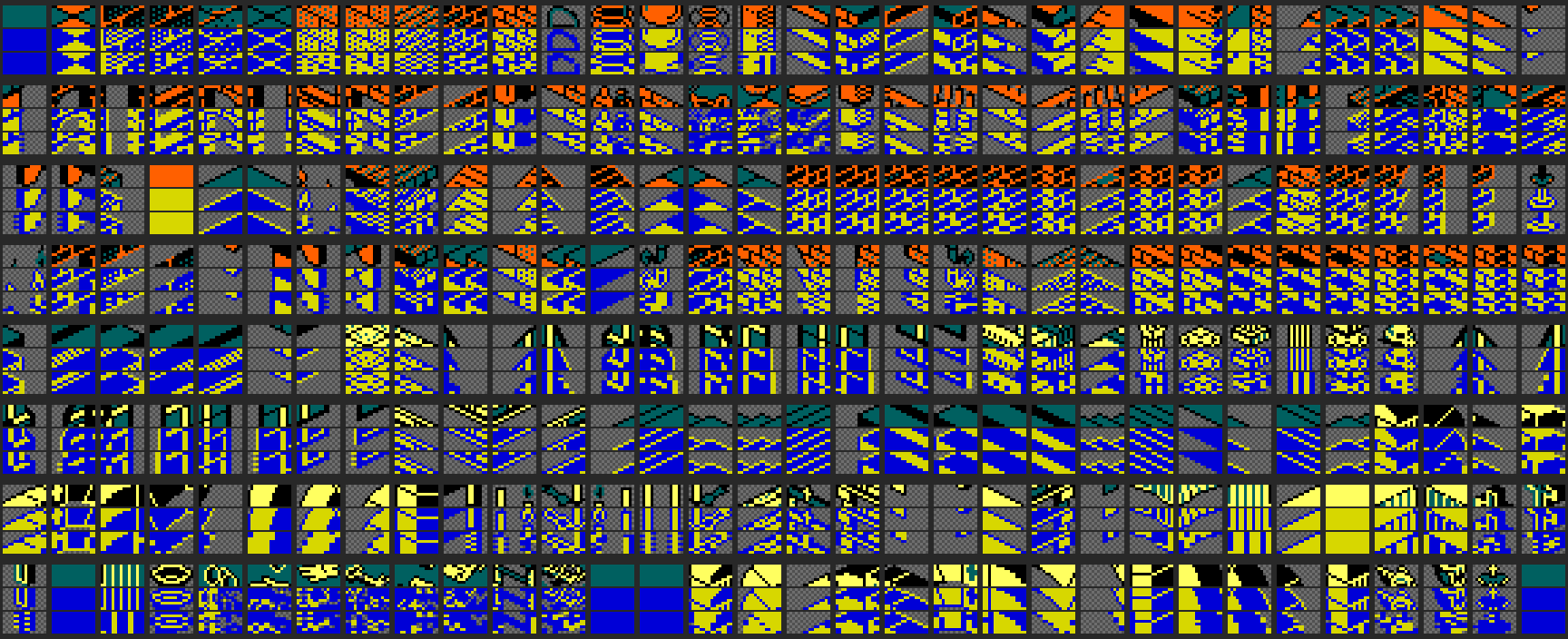
Each 2600 pixel comes from a pair of pixels of the original. The simplest reduction alternates by rows: on even rows it keeps the left pixel and on odd rows the right one. It preserves 50 % dithering and diagonals, but turns one-pixel vertical stripes into horizontal ones, like those on the shafts of the columns.
Liber VII · Capitulum X
The graphics at 128 px
How each pair of Spectrum pixels becomes one 2600 pixel.
A pair, a pixel
The tiles: ten ways, chosen by measuring
For each tile there are ten ways to reduce: alternating by rows or by columns, in checkerboard (and their inverses), always keeping the left or the right one, giving priority to ink or to the gap. The choice is made by measuring on the 94 assembled rooms, not on the isolated tile, so that it fits with its neighbours: the reduced room is compared with the original once both are blurred, which is the tone the eye sees on the TV, and with less weight the horizontal and vertical changes, which say where the strokes are heading. A coordinate descent tries tile by tile until nothing improves. 183 change: the columns recover their vertical stripes, the walls come out less dark and the stairs and windows keep their outline.
The characters: by contrast
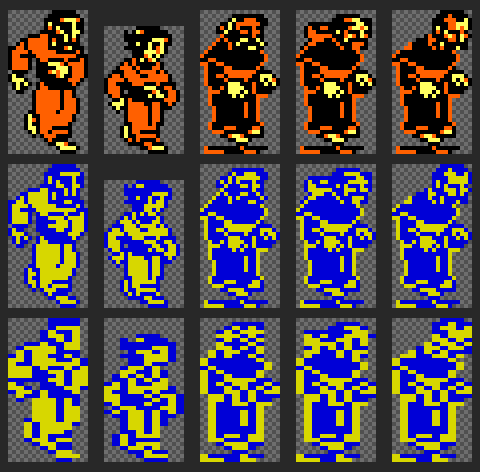
The characters are reduced in a different way, pair by pair and without alternating. If both pixels are the same, that one stays. If one is ink and the other is not, the one that contrasts with its surroundings wins: with a lot of ink around, the gap, because it is the space between two strokes; with little, the ink, because it is a stroke or a detail. On the edge of the silhouette, between paper and transparent, the amount of figure around decides. The heads and bodies of the monks are separate graphics in the original, so each one is reduced with the other as context. They are stored already reduced: the engine places the characters at multiples of 4 pixels, so each column always comes from the same pair.